
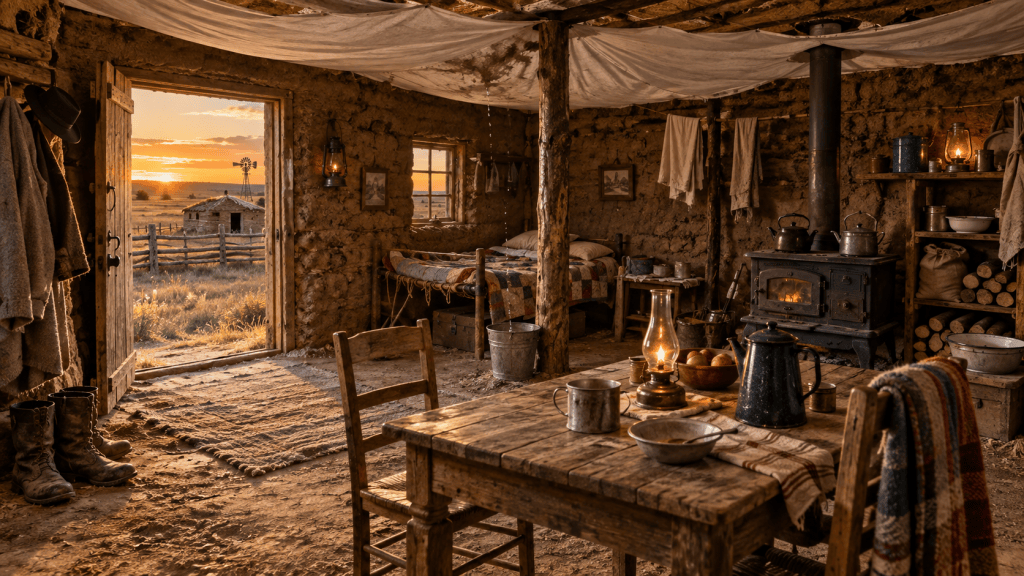
The homes people actually lived in out west looked wildly different depending on where they landed, and the real accounts are considerably funnier, and considerably damper, than the postcard version.
Sod houses were the plains solution to a total lack of lumber, builders sliced the prairie itself into thick bricks with a “grasshopper plow” and stacked them like oversized masonry, no mortar required. Settlers nicknamed the bricks “Nebraska marble,” which is either affectionate or sarcastic depending on how your roof was behaving that week. One family’s 1878 account of moving into a brand-new soddy is not exactly a glowing review, “it commenced to rain, and continued to rain for four days and nights… the roof caved in, with the pole resting on the table.” Sod roofs occasionally sprouted actual wildflowers in spring, charming right up until, as one account put it, they “leaked like a sieve.” Housewives took to tacking muslin sheets under the ceiling specifically to catch falling dirt, beetles, mice, and the occasional snake before it landed in the soup, and those sheets needed washing about twice a year, which tells you exactly how often that was happening.
Not every complaint was minor. Rattlesnakes were a real hazard, one Nebraska doctor’s account recalls being called out because a local boy had been bitten. And yet a well-built soddy could genuinely last, Nebraska History reported that as late as 1970, roughly 150 to 200 families were still living in their original sod houses. My favorite verified line on the whole subject comes from frontier photographer Solomon Butcher, who quit homesteading after exactly two weeks, writing that leaving a boarding house with a steady salary to “lay Nebraska sod for 75 cents a day… was a fool,” which is either the most honest sentence of the entire era or the funniest.
Once lumber arrived by rail, families moved up to log cabins sealed with mud, clay, and chinking, and eventually proper frame houses, a genuine architectural upgrade that quite literally rode in on the train. And along every stage route, “swing stations” offered nothing but a fast horse change, while larger “home stations,” spaced roughly a dozen or more miles apart, actually housed and fed travelers overnight, the frontier equivalent of economy versus full-service.
Which kind of frontier home do you think you’d have made peace with fastest?


Leave a comment