
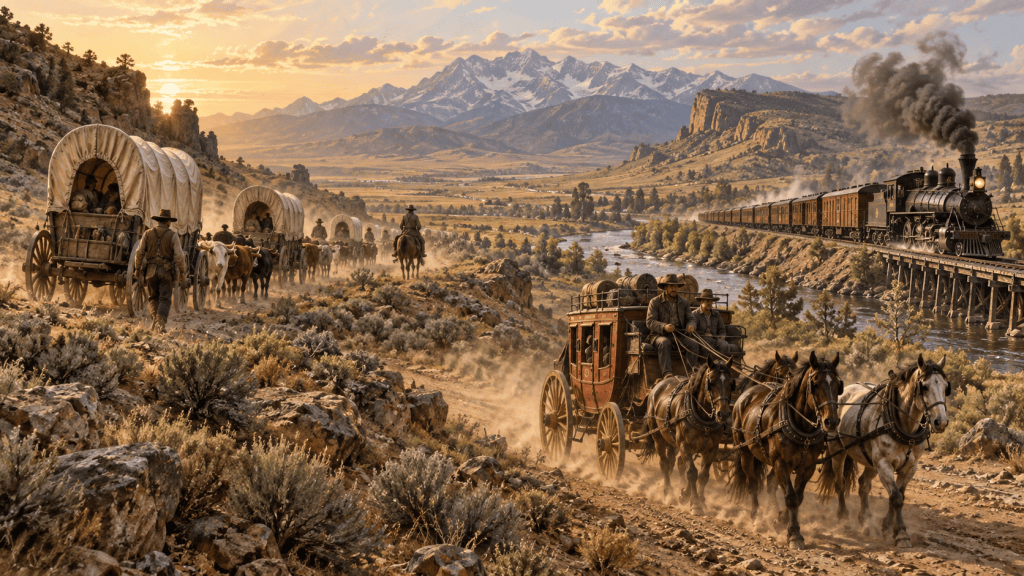
Hollywood makes westward travel look romantic. The true history of getting across the frontier in the 1890s reads a lot more like a very long, very dusty military drill, which honestly makes it better material, not worse.
A wagon train covered a punishing 12 to 15 miles a day, which meant the roughly 2,000-mile trip took four to six months. Mornings started around 4 a.m. with a trumpet blast or rifle shot, breakfast was over by five, wagons were hitched by six, and at 7 a.m. sharp, sharp enough you could set a watch to it, came the call “Wagons roll,” every single day, whether anyone felt like it or not. The one mercy was “nooning,” a full hour’s rest at midday that everyone apparently looked forward to like a holiday. And if a family brought a milk cow along, the wagon’s constant jostling actually churned her milk into butter by evening, free labor courtesy of bad roads.
One myth is worth retiring right here: wagons famously circled at night mostly to pen the livestock and deter thieves, not to fend off attacks the way every old western implies. Much less dramatic. Much more practical.
Stagecoaches weren’t exactly an upgrade. A Concord coach was built so well that the company bragged it never broke; it simply wore out, but that sturdiness didn’t extend to comfort: three bench seats somehow held nine passengers, and a period poem describes the ride as “feet interlacing, heads severely bumped.” Proper stagecoach etiquette required sitting bolt upright the entire way; letting your head loll onto a stranger’s shoulder was considered genuinely rude. As the story goes, some lines even ran a three-tier ticket system: first class rode the whole way seated, second class had to get out and walk the uphill stretches, and third class had to walk uphill and help push.
Then the railroad showed up and made the whole ordeal look almost quaint. By 1876, an express train could cover the same New York to San Francisco route in 83 hours, under four days, that had taken wagon trains the better part of a year. Fares dropped fast, too; a cross-country ticket that cost $125 in the early days fell to $25 or less by 1887, assuming you were willing to ride third class on hard wooden benches while first-class passengers stretched out on velvet Pullman berths a few cars up.
Which leg of that journey do you think you’d have survived best, the wagon, the stagecoach, or holding out for the train?


Leave a comment